

FAQ
Frequently Asked Questions
ODYSSEUS YACHTING HOLIDAYS
Corfu Base
You will find our office on Pontoon A as indicated in the picture below. You can also find our location on google maps. The marina is located at a distance of 6 km from Corfu town. It is only a 15 – 20 min drive from the port or the airport which are both situated in the wider town area.
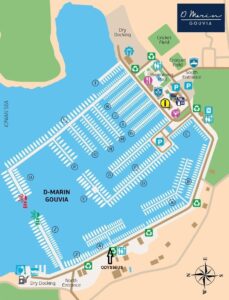
In case you arrive late on Saturday evening, a member of our team will always be there to welcome you on board and help you out with the basic systems of the yacht.
On Sunday morning, we will take care of all the necessary formalities for the “all clear to sail” and, shortly after the technical briefing of the boat is completed, you will be able to depart on your sailing adventure.
If you wish to make the most of your vacation, we can provide you with the following extras:
- SUPs
- Wi Fi connection during the whole charter and
Please ask a member of our team for details.
Our marina offers many facilities such as:
- Restaurants
- Bars and cafeterias
- Super market
- Chandlery (store/shop)
- Toilets and showers
- Laundry and dryers
- Swimming pool
- Fuel station
On the dock:
- Water
- Electricity
Outside and near the marina you will find hotels and apartments, bigger super markets and in Corfu the General Hospital.
Mooring fees in the Ionian are quite inexpensive varying between 15-30 euros per night.
Diesel consumption on boats between 50-100 euros for the week.
Payment terms: 30% deposit upon booking confirmation and final payment 8 weeks before charter.
CHARTER FAQs
Yes, and it’s a very good idea if you want to avoid the chaotic and busy supermarkets on a
Saturday! The marina supermarket can even deliver directly to your boat. Provisioning lists
are available from our office and must be sent to us by 12:00 on Thursday, the week
before your charter.
We recommend stocking up on water for the whole week, some dry goods and a small
amount of fresh food. Remember that a boat fridge can only be used when external power is
available (from the engine, solar panels, shore power or a generator), so those who plan to
anchor in a bay overnight will usually switch the fridge off at night. It’s therefore better to buy
only enough fresh food for a couple of days and top up with local fresh produce from the
various mini markets you’ll find along the way.
Yes. The Ionian has recently become a lot more organised and, as a result, it’s now possible
to make reservations in many harbours. There has also been an increase in the availability
of shore power and water fill-up points. However, this comes at a cost, and depending on the
size of your boat you can expect to pay around €40–€100 for a berth in a harbour.
Alternatively, if you prefer the freedom of anchoring in a bay wherever and whenever you
like, this remains free of charge (with the exception of Agios Stephanos, NE Corfu).
If your boat is 42ft+, the outboard is included! For smaller boats, it’s an optional extra, and it
really depends on how much you plan to anchor and how averse you are to rowing. Most
dinghies are rated for only 3–4 people, so if there are several of you requiring repeat trips to
and from the boat, an outboard can certainly increase your comfort levels during the holiday.
As well as an outboard engine for your dinghy, you may wish to consider some of our other options:
1. Early Embarkation
Want to get sailing straight away on the day you arrive? Early embarkation allows you to
board the yacht and begin your check-in process from 14:00 on Saturday, making a swift getaway possible for those who want to get out for an extra night. Ordinary embarkation time
is 17:00.
2. WiFi
We can provide a WiFi dongle with unlimited internet for your use throughout the charter – handy for avoiding expensive roaming charges from accidentally connecting to non-Greek phone masts nearby.
3. Stand Up Paddleboards (SUPs)
These are very popular, so be sure to book ahead! Paddleboards are great fun for kids and adults alike – perfect for enjoying the sunrise, relaxing at your lunchtime anchorage or settling a competitive game of wobble boards! Ask our office if you’d like to book one.
There are a few different ways you can cover yourself against accidental damage to the
yacht. The important thing to understand is that paying the security deposit is not insurance – it simply means you are accepting responsibility for any damage up to the value of the deposit.
1. Pay the security deposit
You can choose not to take any additional cover and simply pay the boat’s security deposit.
If there is any damage during your charter, the relevant costs will be deducted from the
deposit.
2. Take out your own damage insurance
There are a number of external providers offering yacht charter damage insurance. If you choose this option, make sure you understand exactly what is and isn’t covered by your policy.
It is also very important to take clear photos of the boat before you leave and again at the
end of your charter. These may be required by your insurance provider if you need to make a claim.
3. Take our Damage Waiver
For the simplest option, you can choose our Damage Waiver. This has a non-refundable
element and an excess, but it considerably limits the amount you could be liable for in the event of accidental damage.
The cost varies according to the size and type of boat, so our office can confirm the amount
applicable to your yacht when you book.
You will need a valid International Certificate of Competence (ICC) to charter with us.
If your home country issues its own national sailing qualification, we strongly recommend
having this converted to an ICC before you travel. Local qualifications can be accepted insome circumstances, but the final decision on whether a particular qualification is accepted rests with the local Port Police, and this is outside our control.
An in-date ICC is the only qualification we can reliably recommend to avoid
disappointment when you arrive. Please make sure that the skipper’s ICC is valid for the
type and size of yacht you are chartering.
All our boats carry orange foam life jackets in a range of sizes. When you arrive, please
check that you have the right sizes for everyone in your crew. If you need a different size, just let us know and we can easily swap them from our storage.
If you prefer to use inflatable life jackets, you are welcome to bring your own. Replacement
gas canisters are also readily available from several chandlers just outside the marina,
around a 5-minute walk away.
No problem at all! If you arrive at the base before your boat is ready, the first thing for the
skipper to do is come to our office, located just behind the flagged area, with their ID and a
credit card. We’ll get the necessary paperwork completed and take care of any outstanding
balances.
Once that’s done, you’re welcome to leave your bags in our shaded waiting area and enjoy
the marina while you wait for your boat. There are several bars and restaurants, a play park
and a swimming pool, which is free to use when you purchase a drink.
You can also use this time to do some grocery shopping, although we recommend leaving
any fresh or refrigerated items until later. With temperatures reaching 35°C in summer, they
won’t thank you for sitting in the car or waiting area for several hours!
Your normal embarkation time is 17:00, or 14:00 if you’ve booked Early Embarkation. As
soon as your boat is ready, we’ll let you know and you can get settled in and start your
holiday!
Once your boat is ready for embarkation, you’re free to board and make yourselves at home.
On the chart table, you’ll find a checklist, the first half of which is an inventory list for you to
complete once you’ve located the inventory and safety equipment. As soon as you’ve
finished (don’t worry if there are one or two things you can’t find), let one of us know and
we’ll come to the boat to complete the technical handover with you.
Once the technical handover is complete and you’ve had your weather and area briefing,
you’re ready to set off and start your holiday!
To help things run smoothly on busy Saturdays, we often offer a group weather and area
briefing at 16:15. This gives everyone the chance to get the essential information about the
area and weather before their individual technical handover, as well as a chance to meet the
team and start getting their bearings before heading off for the week.
Yes. All our boats have paper charts covering both the North and South Ionian, along with
the Heikell Ionian cruising guide. Additional charts covering other cruising areas can be
provided on request.
All boats are also equipped with an electronic chartplotter.
All the boats are equipped with at least one 12V outlet. We provide USB chargers for these,
which can usually charge up to two devices at a time. The boats also have 220V mains
power when connected to shore power with a cable. This activates the mains sockets, which
are standard EU 2-pin sockets and can be used for charging larger devices such as laptops
and cameras. Many tavernas are also happy for you to charge your devices there.
Yes. You’re not on your own once you leave the marina!
For most day-to-day issues, a quick message or phone call to us is all that’s needed. We can
often talk you through a problem and get you back on your way without the need for an
engineer. Our phone is also available 24/7 for emergency advice.
If there is a genuine breakdown or technical problem that needs someone on board, we
have our own engineers as well as a network of trusted local engineers throughout the
Ionian. Our flotilla team can also help organise a rendezvous if necessary.
Call-out times depend on the nature and severity of the problem. In some cases, the
quickest solution may be for you to meet an engineer somewhere nearby rather than waiting
for them to come directly to your anchorage. Whatever the situation, our aim is to resolve the
problem as quickly as possible and minimise the disruption to your holiday.
We’ve put together some additional information about choosing your route, what to expect
during the week, mooring arrangements and life on flotilla.
See our Flotilla FAQs ↓
FLOTILLA FAQs
Both routes are fantastic, but they offer quite different sailing experiences, so it’s worth
thinking about what you want from your week.
The South Route takes you through a mixture of old fishing harbours, beautiful bays and
lively villages. In Petriti, you’ll see the local fishing boats bringing their catch straight to the
restaurants, while Lakka offers Venetian charm, turquoise water and plenty of places to explore.
You’ll find everything from quiet bays with just a couple of tavernas to bustling
villages where there’s plenty going on.
The sailing distances on the South Route tend to be a little shorter, giving you more time to
enjoy swimming stops and explore each destination. The wind is also generally a little
gentler than in the north, making it a great choice for less experienced sailors and families,
although you’ll usually still get some fantastic sailing when crossing between Corfu and
Paxos.
The North Route has a more adventurous feel. You’ll visit the beautiful and relatively
untouched Diapontia Islands, where the quieter anchorages and unspoilt scenery make it
easy to feel a world away from it all. You may even spot Odysseus’ petrified ship just south
of Erikousa!
There are still opportunities for some nightlife, particularly in Kassiopi, as well as beautiful
swimming spots along the northeast coast of Corfu, but the North Route is generally quieter
and more focused on nature and sailing. We also aim to spend at least one night anchored
under the stars.
The northern waters tend to see slightly stronger winds, and some of the sailing distances
are longer, so this route is particularly well suited to those who want to prioritise sailing time
and a little more adventure.
We always aim to follow the routes advertised online, but sailing means plans sometimes
need to change. Each week’s route is adapted according to weather, safety and availability,
so you may visit the stops in a different order or even discover a few places that aren’t on
the published itinerary.
That’s all part of the adventure! Our flotilla crews know the area extremely well and will make
sure that, wherever you go, you get to experience beautiful places and have a fantastic
week.
You don’t strictly need one, but many guests find it useful to bring their own handheld
VHF radio. Please note that we don’t provide handheld radios.
When mooring, instructions are often given initially by radio and then followed up with hand
signals and verbal instructions. Having a handheld radio on board means you can stay in
contact with the person helping you without having to keep going up and down the
companionway to the chart table.
Once the initial instructions have been given and confirmed over the radio, we’ll switch to
hand signals and voice, so a handheld radio is by no means essential.
No — and that’s one of the things we love about flotilla!
While harbours are useful for topping up water, stocking up on supplies and enjoying the
atmosphere ashore, some of the most beautiful places in the Ionian are away from the
harbours. Depending on the route and the conditions, you might spend the night stern-to a
quay, at anchor, long-lined to the shore or rafting with the other flotilla boats.
We love being able to finish the day with a swim straight off the back of the boat, so don’t
expect to be tied up in a harbour every night!
We usually have around 3–4 evening activities during the week. These might be as simple
as a punch party or cocktail competition, or something organised especially for the children.
We’ll also usually have 2–3 group meals together as a flotilla.
Everything is completely optional. If you want to get involved, meet other sailors and make
the most of the social side of flotilla, there are plenty of opportunities to do so. If you’d rather
spend some evenings quietly with your family, that’s absolutely fine too. Not every part of
flotilla has to be for everyone!
An outboard can be particularly useful on flotilla. We moor in a mixture of anchorages,
pontoons and quays, and you never quite know how far you’ll be from shore. The best spots
close to the beach tend to disappear first!
Most dinghies are rated for only 3–4 people, so an outboard can also save you from making
several trips if you have a larger group on board.
They’re especially useful for exploring the caves and coves around the Ionian. Many of the
most interesting ones are too deep or rocky to anchor the yacht nearby, but are easy to
reach by dinghy with an outboard.
Tipping isn’t mandatory, but it is always very much appreciated if you’ve had a great week.
Your lead crew work hard throughout the week to make sure everyone has a safe, smooth
and enjoyable flotilla, from helping with mooring and local advice to organising activities and
dealing with the unexpected things that inevitably come up during a sailing holiday.
If you’ve had a fantastic week and feel that the lead crew have gone above and beyond, a tip
is a lovely way to show your appreciation for all their hard work.
SKIPPERED CHARTER FAQs
If you don’t hold a suitable sailing qualification (International Certificate of Competence),
you’ll need to book a skipper for your charter. But even if you are a qualified sailor, having a
skipper on board can be a fantastic way to enjoy your holiday.
A local skipper can show you some of the best swimming spots, anchorages and
restaurants, while also taking care of the trickier bits of sailing — particularly mooring in busy
harbours or when conditions are challenging. It means you can relax and enjoy the holiday
without having to be responsible for everything yourself.
Absolutely! You don’t need to be the skipper of your own boat to join one of our flotillas. If
you’d like to enjoy the social side, support and structure of a flotilla without having to sail the
boat yourself, you can book a skipper to join you.
This can be a particularly good option if you’re new to sailing, don’t hold a suitable
qualification, or simply want to relax and let someone else take care of the sailing and
mooring while you enjoy the week.
Your skipper needs their own private cabin with access to a bathroom. They cannot share a
cabin with guests or use an en-suite bathroom that belongs to another guest.
This is particularly important when choosing a catamaran, as the small forward/V berths are
generally not suitable accommodation for a skipper.
If you’re unsure whether a particular boat is suitable for a skipper, just ask us before booking
and we’ll be happy to advise.
Yes! A hostess or chef can be a great addition to your charter if you’d like some help with
meals and the day-to-day running of the boat.
Like a skipper, your hostess or chef needs their own private cabin with access to a
bathroom, so it’s important to make sure your chosen boat has suitable accommodation
before booking.
A hostess or chef will usually prepare breakfast and lunch on board, as well as one or
two evening meals during the week if requested. You’ll need to provide them with a budget
for provisioning, which they can use to purchase the food and ingredients needed for the
meals.
If you’re considering adding a hostess or chef, let us know when booking and we can advise
which boats are best suited to accommodate them.
Your skipper needs a food allowance of around €20–€40 per day, depending on the
arrangement.
Your skipper is welcome to join you when you eat out, but they may sometimes prefer to
have their own time or eat separately. Even if you invite them to join you, you should still
provide their daily food allowance so they can choose where and when they eat.
No. Your skipper needs adequate time to rest, both during the day and overnight, so that
they can safely operate the boat.
This means your itinerary needs to allow for proper rest periods. You can’t expect your
skipper to move the boat from sunrise to sunset every day, or to get up early after working
late because the group has been up partying.
A well-rested skipper is essential for everyone’s safety, so your skipper will always need to
balance your plans with the amount of rest they need.
Absolutely! Your skipper is there to help you make the most of your holiday, so have a
conversation with them at the beginning of the charter about what you enjoy.
Whether you prefer quiet anchorages, lively harbours, swimming and exploring, long sailing
days or a mixture of everything, let them know. They can then plan an itinerary around the
things you’d most like to experience.
However, the skipper’s main priority is always the safety of everyone on board. The
weather, sea conditions and other safety considerations will therefore always take priority
over the planned itinerary, and your skipper may need to change the plan if conditions
require it.
Tipping is not mandatory, but it is customary and very much appreciated if you’ve had a
great week.
Your skipper is responsible for the safety of everyone on board, as well as helping you get
the most out of your holiday, and a tip is a lovely way to show your appreciation for a job well
done.